VOSITONE Smart Watch ODM Procurement Guide: 3 Pitfalls to Avoid in 2026 + Analysis of Practical Solutions
By Vositone Team 2026.03.30
Lately, in conversations with founders planning new smart watch products, a common frustration has emerged: while market trends seem clear and concepts are strong, the process of finding an ODM partner to bring them to life feels like navigating a minefield. Discrepancies between samples and mass-produced units, persistent issues with key features, or even failing to provide promised eco-certifications—these problems drain not just budgets but, more critically, precious time-to-market and brand reputation.
This anxiety isn’t isolated. According to the latest IDC Worldwide Quarterly Wearable Device Tracker, the smartwatch segment remains vibrant, but growth is increasingly driven by “feature upgrades and scenario segmentation” rather than first-time purchases. This means future products must excel in one or two core experiences. Achieving this excellence depends almost entirely on the technical reserves and engineering capabilities of the ODM partner behind them.
At VOSITONE, working with numerous brands from 0 to 1, we’ve observed that many pre-collaboration “pitfalls” stem from a disconnect in understanding how to implement trends. Today, using the three clearest trends of 2026 as a framework, we’ll break down key pitfalls for B2B procurement and share how we build solutions from a practical standpoint. For a broader industry analysis, our report The VOSITONE Perspective: 2025-2026 Wearable Technology Evolution and Commercial Opportunities offers a more systematic discussion.
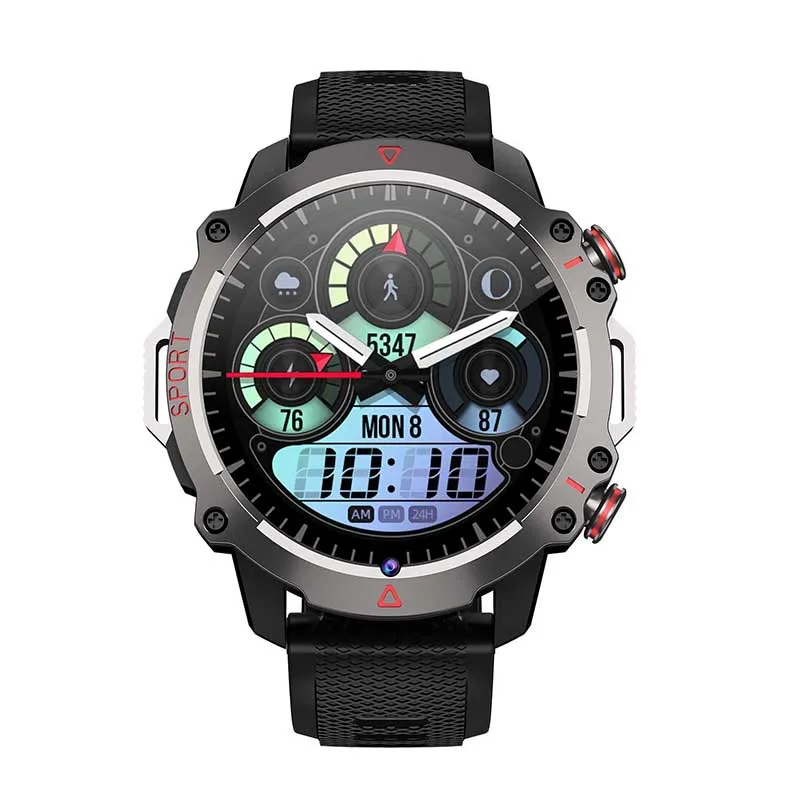
Core Section One: The “Invisible Thresholds” Behind Trends—Don’t Be Blinded by Buzzwords
Advanced health monitoring, AI voice, and sustainable materials are industry consensus. However, if procurement only asks “do you have this feature?”, it’s easy to stumble. The real challenge lies in the “stability” and “compliance” behind the function.
Take health monitoring. Many solutions now claim “non-invasive glucose trend monitoring,” but their technical principles, accuracy levels, and implementation costs vary wildly. Some are merely simple algorithmic estimations based on existing ECG/HR data, offering limited reference value. Others require specialized spectral sensors (like NIR) and rigorous calibration with clinical data. The key pitfall to avoid here is failing to demand that the ODM clearly explain the technical pathway and provide verifiable test data or research partnerships. At VOSITONE, introducing any new health sensor undergoes a lengthy process we call “Sensor-Algorithm Closed-Loop Validation.” Our biosignal lab simulates various bodily states and environmental interference to verify data reliability and algorithm robustness, ensuring we deliver a stable mass-production module, not a lab prototype. The details of this verification system are explored more technically in our note VOSITONE Health Sensor Calibration & Algorithm Optimization in Practice.
Now consider AI voice. The 2026 battleground will be “on-device intelligence”—how many commands a watch can understand and execute offline. This depends heavily on the chip’s NPU performance and the software team’s optimization skills. The pitfall is not looking beyond the checkbox. Focus on the ODM’s partnership depth with chipset providers and their proven track record in low-power wake-word detection and on-device natural language understanding (NLU). We’ve tested different solutions; on the same high-end wearable chipset, a poorly optimized solution might see its wake-word rate plummet in noisy environments, while a well-tuned one remains stable. This work involves the “unglamorous” tasks of.So, instead of asking “do you support AI voice?”, ask “what is the tested wake-word accuracy rate in a XX dB noise environment?”
As for sustainable materials, they are shifting from a “marketing highlight” to a “license to operate.” EU ecodesign directives and major brands’ ESG audits demand traceable proof. The pitfall here is “greenwashing.” Avoid it by explicitly requiring the ODM to provide certificates like GRS (Global Recycled Standard) and corresponding Transaction Certificates (TCs) for key eco-components (case, band). In VOSITONE’s supply chain management, we are progressively building a green materials database, ensuring traceability and verification from the source. This meets client needs and aligns with our own sustainability goals.
Core Section Two: Which Solution Fits Your Business?—A Scenario-Based Needs Analysis
After understanding the technical thresholds, the next step is aligning trends with your specific commercial scenario. Different business models demand entirely different core competencies from an ODM partner.
Scenario A: Cross-Border E-commerce Sellers / Channel Brands. The core need is “fast, compliant, stable”—quickly launching products to catch trends, accurately meeting target market certifications, and ensuring stable supply for sales peaks. These clients need an ODM partner to provide a “compliance roadmap and flexible supply chain.” For instance, a seller targeting Europe and the US must meet CE RED, FCC, and RoHS simultaneously, with strict testing for wireless charging compatibility (Qi standard). VOSITONE’s engineering team translates all these requirements into specific design specifications and corresponding quality control points in production. Our production lines also feature quick-changeover capabilities for last-minute “Black Friday” orders. For such clients, our Global Market Access Certification Guide for Wearables (E-commerce Edition) serves as a checklist to avoid certification risks from the design stage.
Scenario B: New Consumer / Fashion Brands. The core need is “differentiated design and agile innovation.” The product embodies the brand spirit; the exterior ID, UI/UX, and even subtle interaction animations are crucial. They need an ODM partner who is not just a manufacturer but a co-creator with strong design sensibility and rapid prototyping ability. We collaborated with a brand focused on “light sports aesthetics” who needed long battery life within an ultra-thin case. This challenge forced our structural engineers and battery experts to re-plan the internal stacking and customize a shaped battery, ultimately finding the perfect balance between form and function. Such projects test an ODM’s comprehensive engineering problem-solving skills and responsiveness.
Scenario C: Enterprise Clients (Gifts, Employee Welfare, Industry Customization). The core need is “strong brand imprint, high delivery certainty, and cost control.” They may be less sensitive to cutting-edge tech but have extremely high requirements for logo craftsmanship (e.g., fineness of laser engraving, quality of ceramic coating), on-time delivery for entire orders, and cost-control capability for thousands of units. For this scenario, VOSITONE employs a “Standardized Customization Process,” modularizing aspects like appearance customization, software pre-loading, and packaging solutions. This ensures efficiency and quality while meeting personalized needs. Our methodology Enterprise Smart Hardware Customization: Standardized Practice from Concept to Bulk Delivery details this approach designed to reduce communication costs and enhance delivery certainty.
Core Section Three: The VOSITONE Solution in Practice—Our Strengths and Transparent Considerations
Based on our extensive project experience, I want to move beyond marketing speak and candidly share the advantages of choosing an ODM partner like VOSITONE, as well as aspects you should be mindful of.
One of our core strengths is “Depth in Technology Integration and Stability.” A smartwatch is a complex assembly of hundreds of components and millions of lines of code. VOSITONE’s long-term focus has allowed us to build closed-loop capabilities encompassing hardware design, firmware development, algorithm tuning, and mass-production testing. This means when a health monitoring feature acts up, our engineers can troubleshoot from the hardware circuit and sensor driver all the way to the application algorithm, quickly identifying the root cause instead of playing the blame game between suppliers. A real case involved a client’s product with significant GPS drift in cold temperatures. Our analysis traced it to a peripheral power chip underperforming in the cold, affecting the GPS module’s power supply, resolved by adjusting the power management strategy. This deep, system-level debugging capability is something many “assembly-type” factories lack.
Another strength is “Systematization and Transparency in Handling Customization.” We internally categorize customization requests into four levels (L1-L4), each with dedicated resource allocation, processes, and pricing. From simple color/band changes (L1) to modifying hardware functions or developing new UI themes (L3), to co-defining a全新平台的全新产品联合定义 (L4) based on a new platform, each level has clear deliverables and decision points. The greatest benefit of this system is making the collaboration predictable and manageable. Clients understand exactly which stage their request is in, the required time and cost, and the next steps. We believe clear rules maximize efficiency for both parties. The essence of this workflow is detailed in The VOSITONE ODM Project Agile Development & Delivery Process Overview.
Aspects to consider candidly: First, for ultra-small batch, purely exploratory trial orders (e.g., 50-100 units with highly uncertain R&D requirements), our resource allocation and prioritization may not be as efficient as for well-defined mid-to-large projects. While we have an “Innovation Incubation Channel” for early-stage ideas, this typically requires clearer project planning and joint evaluation. Second, due to our commitment to standardized development processes, clients accustomed to frequent, last-minute changes might perceive our pace as “not fast enough.” Our experience has repeatedly proven that thorough discussion and requirement finalization upfront is the shortest path to efficient execution and on-time delivery.
Pre-Conclusion Core: Frequently Asked Questions (FAQ) on VOSITONE ODM Collaboration
Compiling the most common client inquiries, here are 5 representative questions:
Q1: What is the typical timeline from project kick-off to mass production for a VOSITONE smart watch ODM project? A1: The timeline depends on customization depth. Standard processes: Minor public model adjustments (color/Logo) take approximately 6-8 weeks. Medium customization (hardware function modification / new ID design) typically requires 12-16 weeks, including mold development and trial production. Deep co-development (new platform) needs 20+ weeks for detailed definition and validation. At project kick-off, we provide a detailed milestone plan based on a Gantt chart.
Q2: What is the Minimum Order Quantity (MOQ)? Can you support small-batch trial production? A2: For mature public models, the standard MOQ is 500 units. However, understanding the need for market validation, we offer a “Small Batch Trial Production Plan” for promising innovative projects. The specific quantity depends on customization content, material commonality, etc. The goal is to support your first step while managing risk.
Q3: If my product requires medical certification (e.g., FDA or CE MDR), what support can VOSITONE provide? A3: We offer technical support throughout the process: 1) Selection Phase: Recommend hardware platforms already certified or easier to certify. 2) Development Phase: Design and test according to certification requirements, assisting in preparing technical documentation (e.g., software architecture description, risk analysis report). 3) Certification Phase: Cooperate with certification bodies for testing and inquiries. We act as the technical solution provider and factual document preparer.
Q4: How does VOSITONE ensure the traceability of eco-friendly materials used? A4: We have strict green supply chain management procedures. Key eco-materials (e.g., recycled plastics, bio-based materials) must come from qualified suppliers with valid certifications like GRS or UL Ecologo, and we require them to provide corresponding Transaction Certificates (TCs). These documents are part of our quality management system and are available for client audit or review.
Q5: What are VOSITONE’s capabilities in on-device AI voice? What typical functions can be implemented currently? A5: We continuously invest in on-device AI R&D. Currently, based on mainstream high-performance wearable chipsets (e.g., Snapdragon W5 series), we can stably achieve: high-accuracy offline wake-word detection, local core command set recognition (e.g., fitness control, setting reminders), and simple contextual dialogue based on微型模型. More complex multi-turn conversations and deep semantic understanding still require cloud capabilities. We are exploring the application potential of next-generation on-device large language models with algorithm partners.
Conclusion: Practical Advice for Procurement Decision-Makers
After this detailed discussion, here is some practical advice for those making ODM procurement decisions: First, adopt a “problem-solving” dialogue approach. Don’t just ask “do you have it?”; ask “how is it implemented?”, “how is it verified?”, and “how do you resolve issues if they arise?” The supplier’s answers reveal their true expertise. Second, value “non-technical” capabilities. Project management processes, quality control systems, supply chain stability, and compliance experience often determine a project’s success more than any single technical spec. Third, clarify your core needs and prioritize them. Are you pursuing极致创新, or ensuring stable delivery? Is cost sensitivity or quality the priority? Clarity here helps you find the right match faster.
The smartwatch competition ultimately hinges on comprehensive supply chain capability. At VOSITONE, we strive to be the reliable “manufacturing brain” behind brands through transparent processes, deep technical integration, and systematized customization. If you are evaluating smart watch ODM solutions with high requirements for product reliability, innovative implementation, or global compliance, we welcome the opportunity to discuss your ideas. Perhaps the numerous cases and modules housed in our VOSITONE ODM Technology Solution Library can add a measure of certainty to your next product’s success.


Copyright © 2026 Vositone Technologies. All rights reserved. | Privacy Policy | Terms of Service | Health Content Disclaimer
Vositone is a professional smartwatch manufacturer providing OEM, ODM and wholesale services.


