APEC CEO Summit Opens in Shenzhen: 2,000 Delegates, a 30-Year First
SHENZHEN — The APEC CEO Summit 2026 opened here on Tuesday, 17 November, and runs for two days. The Xinhua readout, carried by the State Council Information Office's English site on 18 November, finally put numbers on the room: more than 2,000 representatives, from 21 APEC economies and 13 non-APEC economies. 1
But the line worth keeping is not the headcount. The same readout says the summit is expected to launch a "Shenzhen initiative," and that this would be the first time in the event's 30-year history that an outcome document is issued in the form of an initiative. 1
In other words, the numbers describe the room. The format describes the intent.
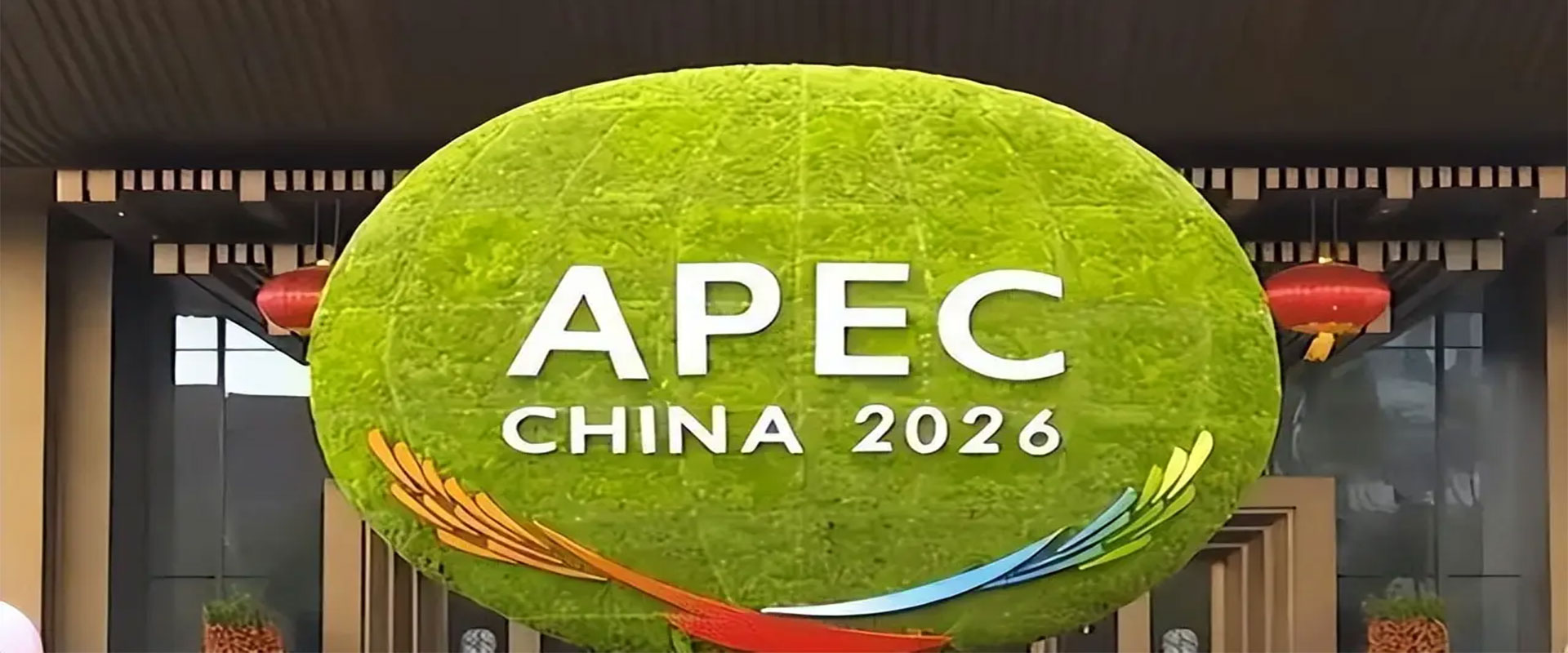
Three sets of numbers: a summit reported at half size
First, the scale. Earlier briefings put attendance at roughly 1,000 government and business delegates. The readout says more than 2,000, which is double. The gap almost certainly lies in what is being counted: the earlier figure probably covered government and business delegates, while the readout covers everyone from 34 economies.
Beyond that, 13 non-APEC economies sent people, including Britain, France, Germany and Switzerland. 1 So this is not purely a Pacific Rim gathering; four European economies alone are in the room.
Then there is the corporate weight. Delegates from 115 Fortune Global 500 companies are attending, alongside heads of several international organizations and business associations from Russia, the United States and elsewhere. 1 Notably, among companies from outside China, U.S. firms form the largest single group, at nearly 20 percent of the total. 1
That 20 percent needs a caveat, however. The original reads "nearly 20 percent of the total," without specifying whether "the total" means all participating companies or only the non-Chinese ones. 1 Treat it as an order of magnitude, therefore, not as a share to put in a chart.
Finally, the host. The summit is organized by the China Council for the Promotion of International Trade, whose chairman, Ren Hongbin, chairs the event. 1 In his welcome address he said he hoped the dialogue would spark new ideas and forge broad consensus, injecting fresh momentum into the Asia-Pacific community and global growth. 1
The Shenzhen initiative: a change of format, not of wording
This is the hardest fact in the readout, and the easiest one to ruin.
To be clear, the CEO Summit has been held annually since 1996 and bills itself as the highest-level platform for APEC economy leaders and business representatives to discuss open cooperation. 1 So for three decades it has produced outcome documents. It has simply never produced one labelled an initiative.
What does a change of format actually mean? In practice, declarations and reports tend to be filed and forgotten. An initiative carries a call to action, and usually implies machinery: signatories, a delivery path, a date on which somebody checks progress.
That said, the readout uses the word "expected." 1 As of publication no text has been released, no signatory list exists, and no timetable for implementation has been announced. Calling it a milestone, therefore, runs ahead of the evidence.
To be precise: it opens a precedent in form. The substance still has to arrive.
The hierarchy of texts: statement, declaration, initiative, agreement
To judge the weight of the change, it helps to see where each kind of document sits.
The lightest is a chair's statement, issued by the host alone, summarising what was discussed and creating no obligations at all. Next is a joint declaration, which requires everyone's assent but leaves most clauses as political commitments, enforced by credibility rather than law. Then comes an initiative, which typically names actors, sets out a route and sometimes carries projects that participants volunteer to claim. The heaviest is an agreement, legally binding and subject to ratification.
Evidently, moving from declaration to initiative crosses the line marked "who is responsible." A declaration can say we note the problem. An initiative has to say we intend to do this.
Mind you, APEC is a non-binding forum; its outcomes have always depended on voluntary implementation. An initiative's real force inside that framework therefore rests on three things: whether anyone claims it, whether resources follow it, and whether there is an annual stocktake. Remove one, and it degrades into a better-worded declaration.
At the same time, this explains why "first in 30 years" deserves attention. It is not wordplay. It nudges a body accustomed to expressing positions a small step toward delivering things.
Why the business summit goes first
The sequencing is not accidental.
In effect, business views are aggregated through the APEC Business Advisory Council and then passed up to leaders. Placing the CEO Summit the day before the leaders' meeting lets those arguments firm up first.
This year the CEO Summit runs 17-18 November, and the 33rd APEC Economic Leaders' Meeting follows on 18-19 November. 1 On opening day, then, the room talks industry and rules. From the 18th, the conversation climbs to political consensus.
Put simply, business puts the questions on the table and leaders supply the direction. That order is the design — and it is what separates this from an ordinary trade fair.
Three industry threads in the agenda
Spread the sessions out, and the hosts have chosen their subjects narrowly.
First comes AI. The stated topic is building "an open and inclusive AI innovation ecosystem," with the emphasis landing on open and inclusive. 1 Notably, those two words are about more than capability; they are about who writes the rules. For hardware firms, once a standard sets, every link in the supply chain has to change with it.
Next comes connectivity, framed as a "new blueprint." 1 That points at logistics, customs clearance and mutual recognition of standards — old problems hunting new answers. APEC has discussed this for decades, so a new blueprint is an admission that the old framework no longer fits.
Third comes the pairing of digital and green transformation, rather than treating them separately. 1 Which means decarbonisation and digitalisation are framed as two faces of one problem, not two budgets. The consequence for manufacturers is direct: count them separately and you fund two retrofits; count them together and one retrofit may satisfy both targets.
Meanwhile, the Free Trade Area of the Asia-Pacific, digital economy cooperation and the Greater Bay Area each get their own session. 1 Evidently Shenzhen is not merely the venue; it is also the specimen.
Shenzhen as specimen: why the Greater Bay Area gets its own session
The Greater Bay Area session deserves a paragraph of its own.
On paper, APEC is a mechanism between economies, while the Greater Bay Area is a regional plan inside one country. Different layers entirely. Yet the hosts gave it a standalone slot, and the purpose is plain: let attendees look not at a policy document but at a supply chain you can drive end to end in half a day.
Specifically, Shenzhen's hardware engineering, Hong Kong's financial and legal interfaces, and the manufacturing hinterland of Dongguan and Huizhou form a combination that is hard to replicate elsewhere, because it needs both manufacturing density and institutional doorways.
That said, a specimen is a specimen because of how it runs on an ordinary Tuesday, not because of how it is staged during summit week. So the test is modest: how many attendees want to come back with a purchase order.
Returning to the summit itself, three threads plus one regional session make the intent legible. AI is about whose standards win. Connectivity is about lowering costs. Digital-and-green is about choosing a retrofit path. And the Greater Bay Area is there to show the first three landing somewhere real.
What business actually asked for
Antonio Basilio, director of the secretariat of the APEC Business Advisory Council, offered a notably practical assessment.
Specifically, he called China's three priorities — openness, innovation and cooperation — "particularly relevant today," and said he expected constructive dialogue that would let businesses trade and invest under more coherent, transparent and predictable rules. 1
Coherent, transparent, predictable: those three words are the actual ask. More slogans do not lower the cost of operating across borders; stable rules do. And the three map onto three familiar pains — incoherence doubles compliance costs, opacity turns decisions into guesswork, unpredictability keeps long-term investment on the sidelines.
Which is precisely why the format change matters. If the initiative lands on commitments that can be checked, companies gain something to plan against. If it is merely well worded, it will differ from previous declarations in little but its label.
From meeting to machinery: one observable test
There is a simple way to judge whether a host year worked: is anyone still citing it twelve months later?
Broadly, APEC outcomes come in three grades. The lowest is a meeting held and a declaration issued, with attention lasting a week. The middle grade is a working mechanism — a standing group, an annual report. The top grade is a named public good, which is where an initiative sits.
Whether the Shenzhen initiative holds therefore depends on two variables: whether the text is specific, and whether anyone picks it up afterwards. The first is settled this week. The second takes a year.
Notably, APEC has seen initiatives become durable mechanisms, and it has seen plenty stay on paper. The difference rarely lies in the launch ceremony. It lies in whether some economy or institution is willing to put money and staff behind it.
The host-year ledger: 300 events and 50 outcomes
The readout also carries cumulative figures that had not travelled widely.
By the numbers, China has hosted more than 300 APEC meetings and events this year, drawing over 10,000 participants in total, and has reached nearly 50 practical outcomes with other member economies in the economic and trade field. 1
What those figures do is stretch summit week into a host year. And they explain why the city's traffic controls look so heavy this week: 300-odd events all have to be closed out in the same few days.
At the same time, they are a reminder not to judge a host year by its opening ceremony. The real work happens in technical sessions with no live feed.
Outside the hall: the city on day one
A news blog should not cover only the hall. On opening day, the Shenzhen side of things is worth recording too.
Start with the border. Hong Kong Immigration Department departure-wait figures, checked at 20:00 HKT on 18 November, put all six major Shenzhen-Hong Kong crossings at around five minutes, with Futian Port flagged as the best option at that moment.
Note, however, that the hour did much of the work. Weekday evenings after 8 p.m. and mornings before 7 a.m. are the calmest windows, and 18 November was a Wednesday. Half of that clean reading, therefore, belongs to the clock rather than to summit logistics.
Then the roads. From 17 to 20 November, between 06:00 and 22:00, passenger cars on plates other than Guangdong-Shenzhen are barred from all roads in Futian, Luohu, Nanshan, Bao'an, Longgang and Longhua. Taxis, ride-hailing cars, coaches and Hong Kong or Macau plates are exempt. Rental cars are not.
And the exemption turns on the plate, not on what the car is doing. A licensed ride-hailing car on a Guangzhou plate may pass; a private car on a Guangzhou plate may not, even if it is only dropping someone at a venue.
Above the streets, the airspace has its own regime. Inside the box formed by Xinzhou Road to the east, Nonglin Road to the west, Beihuan Avenue to the north and Binhe Avenue to the south, unauthorised low-altitude flying is prohibited through 24:00 on 23 November — drones, FPV aircraft, model aircraft, paragliders, balloons, kites and sky lanterns included. Notably, being outside the box does not mean clearance to fly; permission still governs.
Meanwhile, full bag screening and handheld checks on the metro have been routine since 20 July, with no end date. That queue belongs in your commute calculation. The consolation is that since 10 September every gate has accepted eligible contactless foreign bank cards, provided small-value PIN-free payment is enabled.
Governance: exhort where you can, mandate only where you must
Lay this week's measures side by side and a logic appears: use persuasion wherever compulsion can be avoided.
In practice, flexible working is "encouraged," the green-travel registration is "voluntary," police advice to e-bike owners is an "appeal," and the port office's peak-spreading notice is only a "call." Against that, only three instruments carry real force: the non-Shenzhen plate ban, the vehicle-type restrictions on freight and hazardous goods, and the low-altitude controls.
This is a different path from Beijing's APEC in 2014, when offices and schools closed for six days and odd-even driving ran from 3 to 12 November. That was a broad, hard package. Shenzhen, by contrast, has kept compulsion inside a narrow perimeter and left the rest to firms and individuals.
Consequently, the way you assess risk has to change too. What you need to guard against is not a citywide shutdown but a notice posted after you have already left. Watch specific orders, in other words, rather than the general mood.
The question nobody has answered: where is the venue?
Even now, the venue has not been named.
The readout says only that China will hold the 33rd APEC Economic Leaders' Meeting in Shenzhen from 18 to 19 November. 1 The city is confirmed. The building is not.
In fact, that matches every earlier official text. Reporting last November pointed to the Shenzhen International Exchange Center at Xiangmi Lake in Futian, and the city confirmed in August that the building hosted the APEC forestry ministerial in late July. Yet from the leaders' announcement to this week's readout, the official line has stopped at "Shenzhen."
The safest formulation, therefore, is that Xiangmi Lake is highly likely, not confirmed. For a traveller that distinction is practical: it decides whether you book beside the venue, and how you plan those days' commutes.
A correction
Here I owe readers a correction.
In earlier pieces I wrote that Shenzhen expected roughly 1,000 government and business delegates at the CEO Summit. That figure came from an earlier municipal briefing. It now looks clearly at odds with the readout's "more than 2,000 representatives." 1
That said, the two need not contradict each other. The earlier number may have counted government and business delegates only, while the readout covers everyone from 34 economies. And attendance beating an early estimate is hardly unusual at events of this size.
Even so, my earlier phrasing was loose. More accurately: the early estimate was about 1,000; the reported attendance exceeds 2,000; the definitions probably differ.
Reporter's notebook: high density, narrow scope
Reading the readout, one impression lands hard.
True, the 2,000 delegates, the 115 Fortune Global 500 firms and the nearly 50 outcomes arrive cleanly stated. 1 Yet which building the meeting sits in, and which road may close beside it, still have no official answer.
And that asymmetry falls on ordinary people. Delegates need to know whether they will get in on time; commuters need to know which road to take tomorrow. Neither question sits inside the frame of an opening-day story.
Which is why I have been wearing a VOSITONE watch this week to log my own sleep and resting heart rate. Summit weeks run on dense information, and verification has a way of eating the hours you would have slept. The watch's reminder is plain: three nights of short deep sleep and judgement starts to slip — and judgement is precisely what this week demands.
That said, a watch is a reference tool, not a medical device. It cannot diagnose anything, and it should not become a new source of anxiety. Keep the boundary clear and the data stays useful.
Four readers, four ways in
If you work in the industry, watch the agenda and the format. Three industry threads will determine where money and attention go over the next year.
If you are an investor, watch the verbs. "Encourage," "support" and "promote" mean voluntary; "commit," "establish" and "set up" mean resources.
If you run a local business, watch the delivery clauses. Whether a summit produces orders depends on customs facilitation and mutual recognition of standards, not on the scale of the opening ceremony.
And if you are simply in Shenzhen on business this week, watch the traffic. No number from inside the hall will tell you how long Nanshan to Futian will take tomorrow.
In other words, one readout, four readings. And the four do not conflict.


Copyright © 2026 Vositone Tech. All rights reserved. | Premium Smart Watch Manufacturer | Health Content Disclaimer | Privacy Policy | Terms of Service | SiteMap
Vositone® – Professional Smartwatch, Smart Band, Smart Ring & Health Tracker OEM/ODM Manufacturer. CE, FCC, RoHS, IP68 Certified.